

ACJC 2022 Adapted
Evidence has shown that the workers’ participation rate for skills upgrading workshops is generally low, mainly due to ‘short- sightedness’ by both firms and employees. Firms are worried that trained workers quit to join the competitors. Training subsidies provided are also unevenly distributed to different industries.
(a) Explain how the market for skills training may fail.
Introduction
Market failure occurs when the free market fails to allocate resources efficiently, leading to a loss of net social welfare. In the case of skills training, both firms and workers underinvest due to positive externalities, imperfect information, and moral hazard.
R1: Market failure due to positive externalities in consumption
There is a market failure because skills training generates positive externalities in consumption.
Consumers who are utility maximisers will consume where marginal private benefit (MPB) = marginal private cost (MPC). MPB refers to the additional benefit from one more unit of training, such as higher income or improved employability for a worker, or higher productivity for a firm. MPC refers to the additional cost of training, such as course fees, foregone income, or lost work hours. Hence, in the free market, the equilibrium quantity of training is at Qₑ, where MPB = MPC.
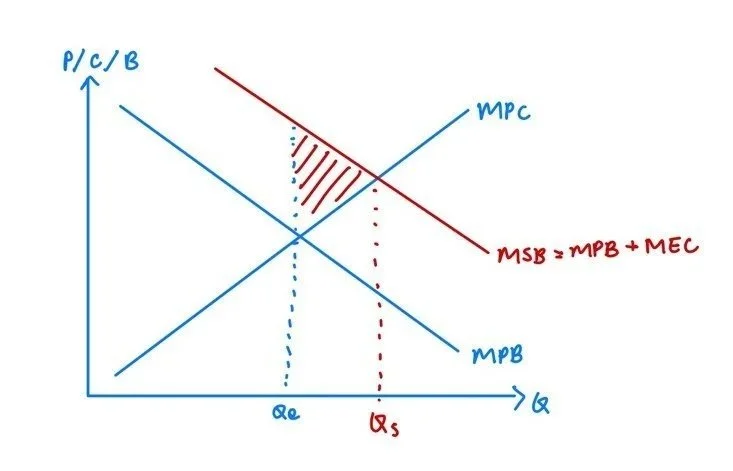
However, training creates marginal external benefits (MEB) to third parties, such as knowledge spillovers to co-workers, benefits to future employers, and higher productivity for society at large. This results in a divergence between MPB and marginal social benefit (MSB), where MSB = MPB + MEB.
The socially optimal quantity of training should be at Qₛ, where MSB = MPC. Since the market only considers MPB, training is under-consumed by the amount (Qₛ – Qₑ). The result is a deadweight welfare loss (DWL) represented by the shaded area between MSB and MPC from Qₑ to Qₛ, indicating allocative inefficiency (AIE).
R2: Market failure due to imperfect information
There is also a market failure because both workers and firms suffer from short-sightedness and underestimate the true benefits of training.
Consumers who are utility maximisers will again consume where MPB = MPC. Here, the perceived MPB (MPBᵖ) refers to the additional benefit from training that workers and firms believe they will gain — such as small wage increments or short-term productivity boosts. The MPC includes course fees, time cost, and forgone output. Hence, in the free market, training is consumed at Qₑ, where MPBᵖ = MPC.
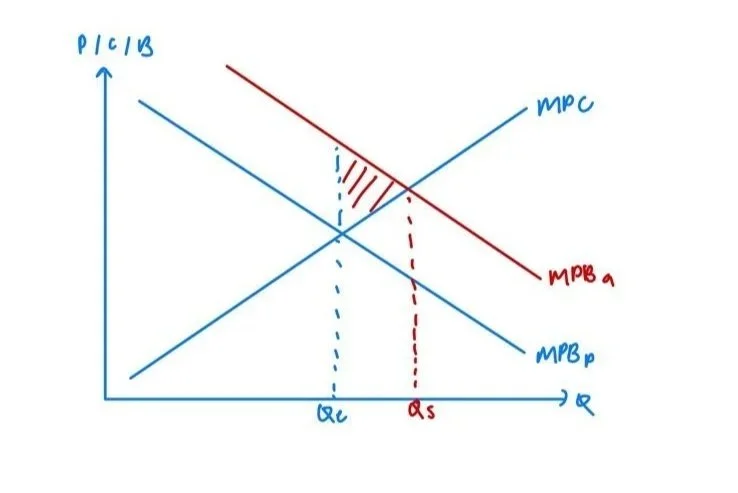
However, agents fail to account for the full, actual MPB (MPBᵃ). Workers underestimate long-term wage growth, employability, and career security, while firms underestimate future productivity and innovation gains. This leads to a divergence between MPBᵖ and MPBᵃ.
The socially optimal quantity of training should be at Qₛ, where MPBᵃ = MPC. Since consumption occurs at Qₑ based on MPBᵖ, training is under-consumed by (Qₛ – Qₑ). This again causes a DWL, with resources misallocated and allocative inefficiency.
R3: Market failure due to asymmetric information (moral hazard)
There is also market failure due to asymmetric information, which arises when one party in a transaction possesses more or better information than the other. In the case of training, this occurs after training is provided, giving rise to moral hazard.
Moral hazard is a situation where one party engages in hidden actions that the other party cannot perfectly observe, shifting costs or risks away from themselves. For example, once firms pay for workers’ training, employees may quit soon after to join competitors or may reduce effort in applying their new skills, since firms cannot fully monitor post-training behaviour. Similarly, when subsidies are given directly to workers, some may attend courses just to obtain certificates without putting in the effort to acquire genuine skills, as the government cannot observe their learning quality.
Because firms and the government anticipate these hidden behaviours, they may cut back on the level of training or subsidy provision. As a result, the market outcome remains at Qₑ < Qₛ, leading to under-provision, deadweight welfare loss, and allocative inefficiency.
Conclusion
In summary, the market for skills training fails due to (i) positive externalities in consumption, (ii) imperfect information causing MPBᵖ < MPBᵃ, and (iii) moral hazard. In each case, the market equilibrium occurs at Qₑ where MPB = MPC, below the socially optimal Qₛ, causing under-consumption, DWL, and allocative inefficiency.
