

ACJC 2022 Adapted
Evidence has shown that the workers’ participation rate for skills upgrading workshops is generally low, mainly due to ‘short- sightedness’ by both firms and employees. Firms are worried that trained workers quit to join the competitors. Training subsidies provided are also unevenly distributed to different industries.
(b) Discuss whether free provision for upgrading workshops is the best policy to increase efficiency in the skills training market. [15]
Introduction
The market for skills training fails due to three main reasons: positive externalities, imperfect information, and moral hazard. Different policies are therefore required to correct each failure: free provision to address positive externalities, public education to reduce imperfect information, and incentive mechanisms to mitigate moral hazard. This essay evaluates whether free provision is the best policy relative to these alternatives.
R1: Free provision to correct positive externalities
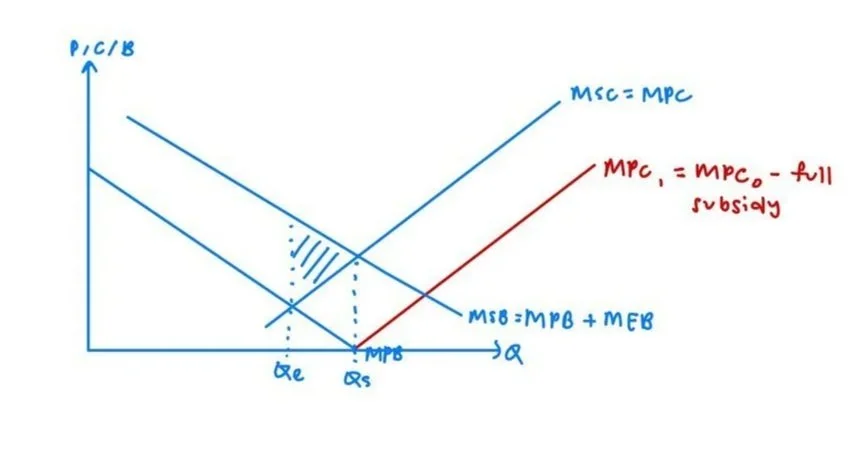
There is market failure due to positive consumption externalities in training. Left to the market, workers and firms consume at Qₑ where MPB = MPC. MPB is the additional benefit to the decision-maker from consuming one more unit of training, such as additional income, promotions, or productivity gains, while MPC is the additional cost of consuming one more unit of training, such as course fees, time spent, and foregone output. However, training generates MEB to third parties, such as knowledge spillovers to co-workers, productivity gains to future employers, and higher national competitiveness. Hence, MSB = MPB + MEB, and the socially optimal level is at Qₛ where MSB = MSC (= MPC).
To address this, the government can implement free provision, which is essentially an indirect subsidy — the state directly organises and funds workshops, reducing the effective MPC of workers to zero. Referring to Figure 1, this shifts the MPC curve down from MPC₀ to MPC₁ = MPC₀ – full subsidy, eliminating the financial barrier. Consumption rises from Qₑ to Qₛ, and the DWL between MSB and MPC from Qₑ to Qₛ and the underconsumption is removed, achieving allocative efficiency. In doing so, the policy internalises the external benefit, aligning private incentives with social optimality.
EV1: Oversubsidy and fiscal strain
However, free provision may result in oversubsidy, where consumption extends beyond Qₛ to Q′. At Q′, MSC > MSB, creating a new DWL on the right-hand side of the diagram. Instead of solving inefficiency, resources are now over-allocated to training.
Financing free provision also requires heavy government spending, straining the budget and creating opportunity cost as funds are diverted from other sectors such as healthcare, education, or defence. Furthermore, by fully removing costs, workers and firms may overconsume low-value workshops simply because they are free, crowding out resources from high-return training. Hence, while free provision can eliminate DWL in theory, in practice it risks creating new inefficiencies and fiscal unsustainability.
R2: Public education to correct imperfect information
There is also market failure from imperfect information, where workers and firms underestimate the true benefits of training due to short-sightedness. Workers focus excessively on immediate costs like course fees and time, while undervaluing the additional benefit from each extra unit of training, such as higher lifetime wages and employability. Firms similarly overweight the risk of poaching while undervaluing the additional productivity gains from trained staff.
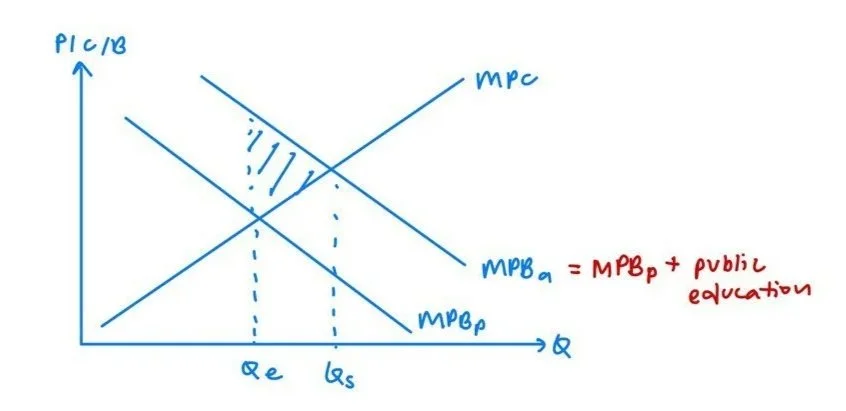
This leads to a divergence between perceived MPB (MPBᵖ) and actual MPB (MPBᵃ). Workers and firms consume at Qₑ where MPBᵖ = MPC, instead of at Qₛ where MPBᵃ = MPC. The result is under-consumption by (Qₛ – Qₑ), giving rise to a DWL represented by the shaded area between MPBᵃ and MPC from Qₑ to Qₛ.
Public education and moral suasion can correct this by shifting MPBᵖ upward toward MPBᵃ= MPBᵖ after campaign. Campaigns highlighting wage premiums, government reports on productivity improvements, and case studies of successful training outcomes reduce misperceptions. Referring to Figure 2, as MPBᵖ rises toward MPBᵃ, the equilibrium shifts from Qₑ to Qₛ, eliminating DWL and improving allocative efficiency.
EV2: Limitations of public education
Nevertheless, education campaigns are often slow and uncertain. Deep-seated short‑termism means MPBᵖ (perceived marginal private benefit) may only partially converge to MPBᵃ (actual marginal private benefit), leaving equilibrium at Q′ < Qₛ — reducing but not eliminating the DWL. For example, only 28 per cent of eligible Singaporeans have tapped the one‑off S$500 SkillsFuture Credit top‑up, even though it's heavily promoted, indicating limited impact of campaigns in changing behaviour. Hence, while public education narrows the MPBᵖ–MPBᵃ gap, it rarely eliminates inefficiency by itself. Campaigns are also costly to sustain, creating opportunity costs since funds could instead be directed to subsidies or infrastructure.
R3: Policies to correct moral hazard
Market failure also arises from asymmetric information, specifically moral hazard, which occurs when one party changes behaviour after an arrangement because the other party cannot fully observe or control their actions.
In training, firms fear that once they finance training, workers may quit to join competitors or exert less effort in applying their new skills. Similarly, if workers receive subsidies, they may sign up for irrelevant courses or attend only for certification rather than genuine learning, since governments cannot monitor effort or outcomes perfectly. Anticipating these hidden actions, firms and governments reduce their ex-ante provision of training, leaving the market stuck at Qₑ < Qₛ.
To address this, policies could include training bonds (where employees must stay with a firm for a minimum period after sponsored training) or co-payment schemes (where workers bear part of the cost, aligning incentives to choose relevant courses).
EV3: Limitations of moral hazard policies
Yet, such policies also carry trade-offs. Training bonds may discourage workers from undertaking training in the first place, especially if they fear being “locked in” to a firm. Co-payment schemes, while aligning incentives, reintroduce financial barriers, which may reduce participation among lower-income workers. Monitoring compliance with training quality standards also adds administrative cost and complexity, risking government failure. Thus, while moral hazard policies can mitigate under-provision, they cannot fully resolve the inefficiency without complementary measures.
Final Evaluation
In conclusion, free provision addresses positive externalities but risks oversubsidy, budgetary strain, and crowding out. Public education tackles imperfect information at its root but is slow, costly, and only partially effective. Moral hazard policies help align incentives but create new barriers or administrative burdens. Therefore, free provision is not the best standalone policy. A policy mix is required: limited free provision for high-return essential skills, public education to raise awareness of benefits, and moral hazard policies to align incentives and reduce hidden-action risks. Such a combination is more effective at moving consumption from Qₑ to Qₛ, eliminating DWL, and ensuring allocative efficiency in the skills training market.
