

J1 Policies for Market Failure (1)
TYS 2022 3b
Street lighting is considered to be a public good. However, there are also negative externalities resulting from the generation of electricity for the lighting on the environment and the effect of bright street lights on wildlife.
b) Discuss the extent to which a government should intervene in the market to ensure that the benefits of street lighting can be obtained while minimising the negative impacts. [15]
Introduction
Street lighting generates multiple forms of market failure. As a public good, it is non-excludable, non-rivalrous, and non-rejectable, leading to complete market failure and under-provision. At the same time, electricity-powered lighting produces pollution and affects nocturnal wildlife, creating negative externalities. The government must therefore intervene to ensure that the benefits of street lighting—such as improved safety and visibility—are obtained while minimising its negative impacts on the environment. In Singapore, the Land Transport Authority (LTA) has directly provided and maintained public lighting while also investing in smart, energy-efficient systems to address these dual objectives. This essay discusses how such policies help correct market failure, and their limitations in practice.
R1: Government should intervene through free direct provision to ensure benefits of street lighting can be obtained (public good)
Street lighting is a public good characterised by non-excludability, non-rivalry, and non-rejectability. Non-excludability means that once lights are provided, it is prohibitively expensive or impossible to exclude non-payers from benefitting. Non-rivalry means one individual’s use does not reduce the quantity available for others, while non-rejectability means individuals cannot avoid benefitting from the light even if they wish to. Because no consumer reveals their willingness and ability to pay, there is no effective demand in the price mechanism, leading to a missing market where private provision is zero.
To correct this, the government can directly supply the good at zero market price through free direct provision. The government either produces street lighting itself or contracts private firms to manage operations under public funding. This ensures that the socially optimal quantity of street lighting, where marginal social benefit (MSB) equals marginal social cost (MSC), is achieved. For example, the Land Transport Authority (LTA) in Singapore installs and maintains all public street lights, fully funded through general tax revenue. This guarantees nationwide access to well-lit roads, improving public safety and ensuring that the benefits of street lighting are fully obtained, thereby correcting the missing market and achieving allocative efficiency.
EV1: Fiscal burden and productive inefficiency
However, free direct provision imposes a significant fiscal burden on the government. Installation, maintenance, and electricity costs are substantial, and funding them through higher taxes may worsen equity, especially for lower-income households. Additionally, government agencies may lack profit incentives or technical expertise, resulting in cost overruns and productive inefficiency. To mitigate this, the government can adopt joint provision—funding infrastructure while contracting private firms for operations. This balances accessibility and efficiency, ensuring fiscal sustainability in the long run while maintaining public welfare.
R2: Government should intervene to minimise the negative impacts by reducing marginal external cost (MEC)
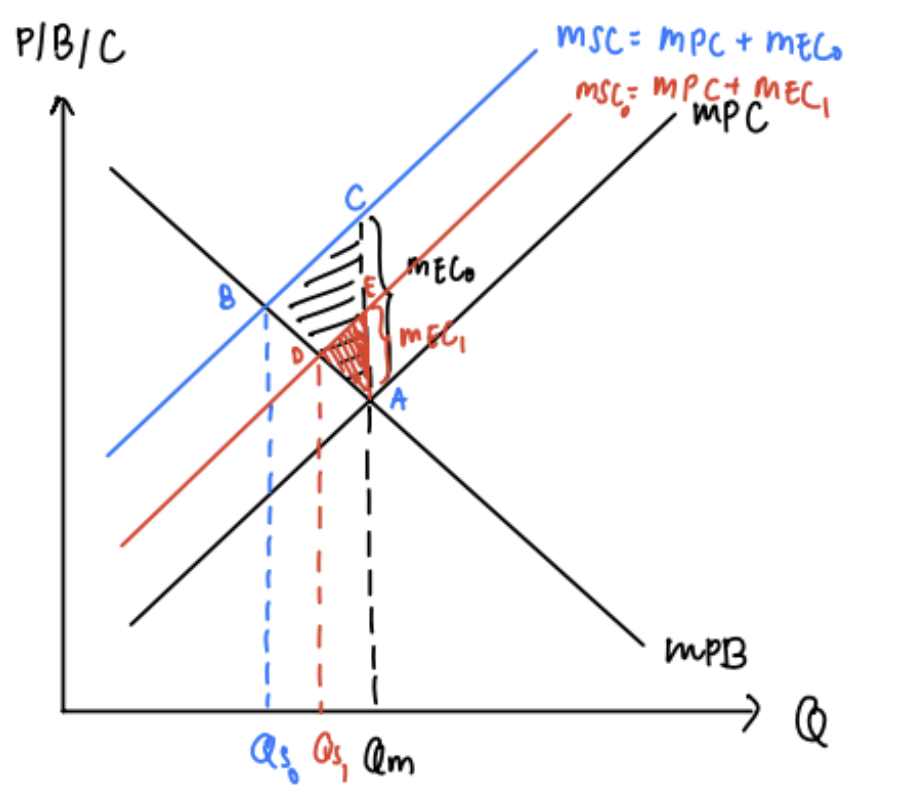
Street lighting also generates negative externalities through electricity consumption and light pollution. Producers base their output on private costs only, producing at Qm where marginal private cost (MPC) equals marginal private benefit (MPB). However, due to external pollution costs such as carbon emissions and habitat disruption, the marginal social cost (MSC) exceeds MPC by the size of the marginal external cost (MEC), where MSC = MPC + MEC. The socially optimal level of output is at Qs, where MSC = MSB. Overproduction at Qm leads to a deadweight welfare loss (DWL), represented by the shaded triangle between MSC and MSB from Qs to Qm, reflecting welfare lost due to excessive production.
To address this, the government can subsidise R&D and adoption of cleaner, more energy-efficient technologies. For example, Singapore’s LTA has introduced smart LED streetlights with motion sensors that automatically dim during low-traffic hours and is progressively switching to solar-powered systems. These reduce pollution and energy usage, lowering MEC from MEC0 to MEC1 and shifting the MSC curve downward from MSC0 to MSC1. Socially optimal level increases from Qs0 to Qs1, reducing the DWL from area ABC to ADE and underproduction from Qs0-Qm to Qs1-Qm and improving allocative efficiency.
EV2: Information gaps, opportunity cost, and long-run effectiveness
The success of such subsidies depends on accurate estimation of MEC and firms’ responsiveness. If the government overestimates MEC, over-subsidisation may result in overspending on low-impact technologies; if underestimated, pollution reduction may be minimal. Furthermore, subsidies carry high opportunity costs—funds spent on R&D could have been allocated to essential public services such as healthcare or education. Finally, while such green initiatives are effective in addressing root causes of pollution, their impact is gradual, as infrastructure upgrades and technology adoption take time. Hence, while effective in the long run, they may yield limited results in the short run.
Conclusion
In conclusion, the extent of government intervention depends on the nature of the market failure, time horizon, and fiscal constraints. In the short run, free direct provision is the most effective measure to correct the missing market caused by the public good nature of street lighting, ensuring immediate provision and safety. In the long run, subsidies for R&D and green innovation are necessary to minimise the negative externalities of production and promote environmental sustainability. Therefore, a balanced combination of direct provision and technological investment ensures that the benefits of street lighting are obtained while minimising environmental and fiscal costs, achieving allocative efficiency over time.
