

J2: Globalisation (1)
TYS 2022 6a
Singapore’s Prime Minister has stated that ‘Globalisation will be under pressure, but it is imperative for countries to cooperate, for businesses to operate across many generations, to tap resources, to bring skills and talents and experiences together, and then serve markets all around the world.’
a) Explain the benefits and costs of globalisation to Singapore. [10]
Introduction
Globalisation refers to the increasing interconnectedness of economies through the flow of trade, capital, and labour across national borders. As a small and open economy, Singapore is highly integrated into global trade and investment networks. While globalisation has been a major driver of economic growth and job creation, it also exposes the economy to external vulnerabilities and labour market challenges.
R1: Increase Trade and Capital Flow leads to Sustained Growth and Fall in Unemployment
Globalisation has brought significant benefits to Singapore due to the increasing trade and capital flows, leading to higher aggregate demand (AD) and sustained economic growth. As trade barriers fall, Singapore’s export-oriented industries, such as electronics, pharmaceuticals, and financial services, gain access to larger global markets. The rise in trade flow directly increases exports revenue (X), shifting the AD curve rightwards from AD0 to AD1. At the same time, greater capital mobility attracts foreign direct investment (FDI) into Singapore, as multinational corporations are drawn by its stable political environment, skilled workforce, and world-class infrastructure. FDI increases quantity and quality of factors of production, hence increasing productive capacity of Singapore’s economy and shifting LRAS rightwards from LRAS0 to LRAS1.
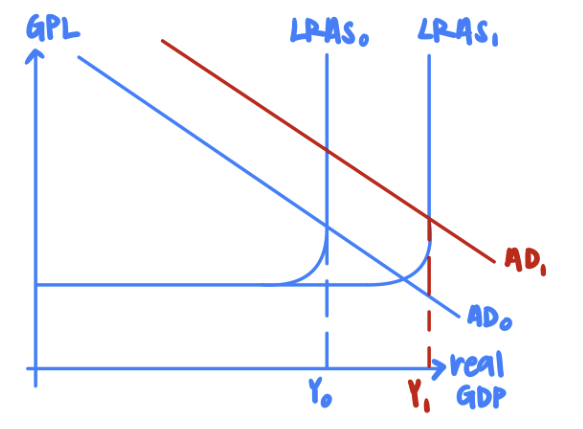
With the initial rise in AD and assuming the economy is nearing full employment, firms face an unplanned decrease in inventories, and this signals firms to increase production including labour. Hence, workers now have higher income and purchasing power to spend on domestic goods and services while the rest is withdrawn in terms of savings, taxes and import expenditure. This would then lead to a further unplanned fall in inventories of other firms, inducing a further rise in income induced consumption and the further increase in AD. The cycle repeats itself until the cumulative increase in withdrawals is equal to the initial change in AD.Hence, the increase in AD leads to further increase in real GDP, resulting in actual economic growth. Demand-deficient unemployment also falls as derived demand for labour increases when firms hire more.
R2: Increase Capital and Labour Flow leads to Structural Unemployment and Fall in Inclusive Growth
However, globalisation can also impose costs on Singapore by contributing to structural unemployment due to increased capital and labour mobility. The inflow of foreign labour and automation technologies heightens competition in the labour market, particularly for low-skilled local workers. For example, Singapore’s manufacturing and logistics sectors have undergone rapid technological restructuring, with automation reducing the need for manual labour. As firms adopt capital-intensive production methods and relocate low-value operations overseas to cut costs, demand for low-skilled workers falls while demand for high-skilled workers rises. This creates a skills mismatch, where displaced workers lack the qualifications or technical skills required for new, high-value jobs. As these workers are occupationally immobile, they remain unemployed resulting in structural unemployment. Moreover, globalisation tends to widen income inequality, as higher-skilled workers benefit more from global demand for advanced skills, while lower-skilled workers face wage stagnation. This undermines inclusive growth as well.
Conclusion
In conclusion, globalisation has played a crucial role in driving Singapore’s sustained economic growth by expanding trade and capital flows, attracting FDI, and creating employment opportunities across sectors. However, it has also introduced structural challenges, including labour market displacement and widening income inequality, which can undermine inclusive growth.
