

J2: Supply-Side Policies (2)
TYS 2020 Q4b
The rate of unemployment in more than 50 of the world’s countries, including several European countries, exceeds 10%. Governments face a difficult decision about whether income tax rate cuts are the most effective policy measure to reduce unemployment to more acceptable levels.
b) Discuss whether a reduction in the rate of income taxes is likely to be the best policy measure to reduce high unemployment in a country. [15m]
Introduction
Unemployment refers to people who are registered as able, available, and willing to work at the going wage rate but unable to find paid employment despite an active search for jobs. The two main types of unemployment that pose a concern to the government are cyclical unemployment, which is also known as demand-deficient unemployment, and structural unemployment. A reduction in the rate of income taxes is an expansionary fiscal policy which can be used to increase aggregate demand (AD) and lower unemployment rate. However, other policies such as supply-side policy can also address the problem of high unemployment rate. Both policies will be further discussed in the essay below.
R1: A reduction in the rate of income taxes is likely to be the best policy measure to reduce high unemployment in a country
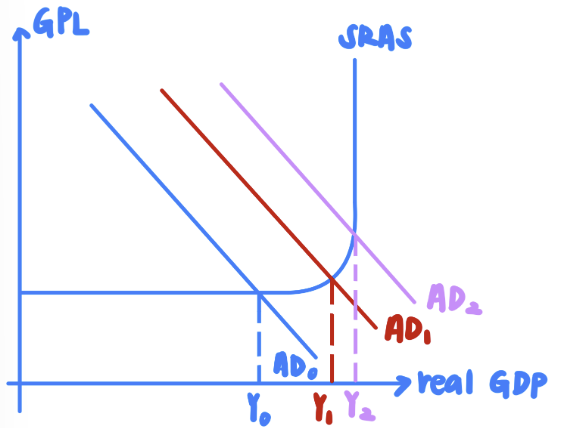
A reduction in the rate of income taxes is an expansionary fiscal policy that can lead to an increase in AD, as explained in part (a). The multiplier effect causes AD to increase by a larger extent from AD0 to AD2, with national income increasing by a larger extent as well from Y0 to Y2. As national income increases, output increases. The increase in demand for goods and services leads to an unplanned inventory depletion, thus more factors of production are needed to match up with rising demands. This will lead to an increase in the derived demand for labour, thus reducing the high unemployment rate in a country.
Evaluation 1
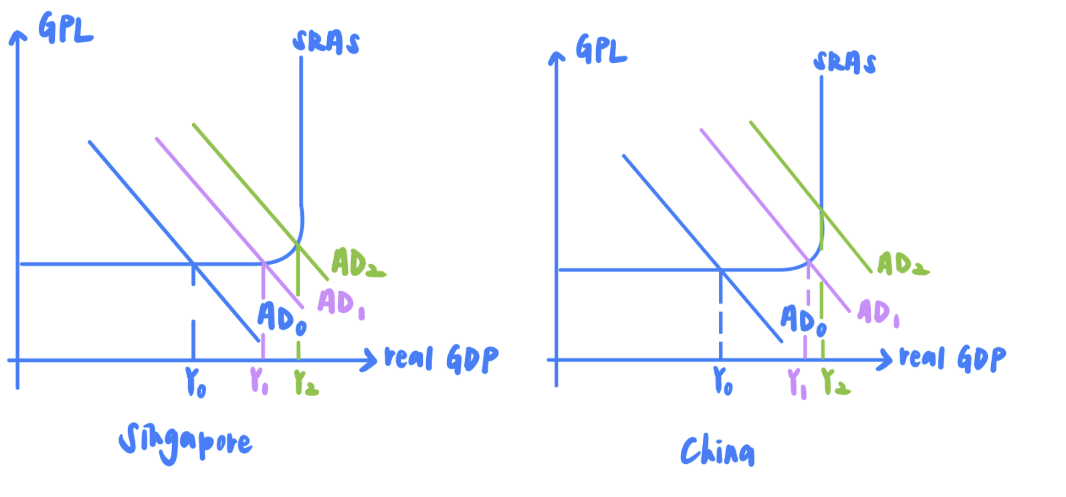
However, the effectiveness of expansionary fiscal policy to reduce high unemployment rate via a reduction in income taxes will depend on the root cause of unemployment and the size of multiplier of an economy. Firstly, expansionary fiscal policy will be the best policy measure to reduce unemployment rate if the type of unemployment is cyclical unemployment, where the root cause of unemployment is due a decrease in AD. However, if the root cause of unemployment is due to structural changes within the economy where there is a mismatch of skills, expansionary fiscal policy will not be able to appropriately address the problem and reduce the unemployment rate. Secondly, the size of multiplier of an economy is also crucial for expansionary fiscal policies to be effective. This is because countries with a smaller multiplier, k (k=1/MPS+MPT+MPM), will see a smaller multiplied increase in AD with a reduction in income taxes, as compared to countries with a larger k. For instance, Singapore has a small multiplier due to a large marginal propensity to save (MPS) and marginal propensity to import (MPM). This is due to Singapore's compulsory saving scheme, the Central Provident Fund (CPF) where employees have to contribute 17% of their monthly income to this scheme, and the habit of saving due to Asian values of thrift. Additionally, Singapore is a small country with limited land, therefore has a high MPM with 40 cents going towards imports with every dollar spent. Thus with a high MPS and MPM, Singapore has a small k, and assuming Singapore’s marginal propensity to withdraw (MPW=MPS+MPT+MPM) is 0.8, the multiplied increase in national income will only be 1.25 times. This is in contrast to countries like China with a huge domestic market and abundant land thus lower MPM. Assuming China’s MPW to be 0.2, China’s multiplied increase in national income will be 5 times. Thus expansionary fiscal policy may not reduce unemployment rate as effectively in Singapore as compared to China.
R2: Supply-side policies can also address high unemployment rates within the economy
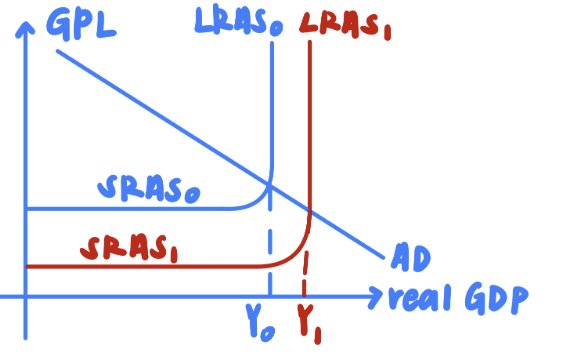
Supply-side policies can be implemented in both the short and long-run to address high unemployment rates within the economy. Firstly, short-run supply side policies such as subsidies can be provided to firms to offset the rise in cost of production during a recession such as the economic downturn caused by the Covid-19 pandemic that left the “unemployment in more than 50 of the world’s countries, including several European countries to exceed 10%”, as mentioned in the preamble. This can not only help with cyclical unemployment, but can also buy time for sunset industries to keep their workers while they undergo retraining in the midst of economic restructuring. The decrease in cost of production such as wages and utilities expenses can help sunset industries sustain a longer period of time, thus decreasing the unemployment rate. The decrease in cost of production will lead to an increase in SRAS, shifting it downwards from SRAS0 to SRAS1. Secondly, long-run supply side policies such as retraining programmes can be implemented to reduce structural unemployment. Structural unemployment occurs when there is a mismatch of skills between what workers are equipped with and what employers are looking for, often due to economic restructuring from labour-intensive sectors to high end technological sectors. For instance, the Singapore government launched Skillsfuture, a retraining and upskilling scheme which granted every Singapore working adult above the age of 25, $500 credits to undergo skills upgrading and retraining. With retraining schemes, workers can bridge the knowledge gap and be equipped with the necessary skills to be offered better opportunities in higher value-added sectors. This improves the productive capacity of the economy thus increasing long-run aggregate supply (LRAS), shifting it to the right from LRAS0 to LRAS1.
Evaluation 2
However, supply-side policies are faced with limitations as well. Short-run supply-side policies such as providing subsidies require large amounts of government funds which will thus incur an opportunity cost as the same amount of money cannot be spent on other sectors of the country such as healthcare and education. Additionally, if the government funds are funded through national reserves or borrowings, it will result in a depletion of resources and an intergenerational transfer of standard of living from future to present, thus hurting sustainable economic growth. Long-run supply-side policies like retraining schemes is a long drawn process that requires a long time to reap the benefits of an increased quality workforce. Therefore, countries with high unemployment rates that require urgent attention and solutions, long-run supply-side policies may not be the best measure to address the problem.
Conclusion
In conclusion, whether or not a reduction in the rates of income taxes of workers and firms is the best policy depends on the root cause of the unemployment and the economic outlook of consumers and firms. A reduction in income tax rates will be suitable to reduce cyclical unemployment through increasing AD but may not be feasible when dealing with unemployment caused by structural changes within the economy. Additionally, a reduction in income tax rates may not be as effective due to the pessimistic economic outlook of consumers and businesses, especially with “more than 50 of the world’s countries” facing high unemployment rates, as mentioned in the preamble. This may result in consumers and businesses holding back on both consumption and investment expenditure as they expect their income levels to be negatively affected over the next few years, due to the recent pandemic. A mix of policies can be used both in the short-run and long-run to better deal with rising unemployment. Developed countries may find supply-side policies more appropriate due to their economic developments that may result in structural unemployment whereas developing countries can reduce taxes to spur growth and generate funds for subsidies to deal with high unemployment rates. All in all, given that “more than 50 of the world’s countries” are experiencing high unemployment rates that “exceeds 10%” according to the preamble, it is more likely that the root cause of unemployment is due to a decrease in AD, due to the covid-19 pandemic. In this case, a reduction in the rates of income taxes will be the best policy to boost growth and reduce high unemployment rates.
