

J1 Externalities + Imperfect Information
ASRJC 2021
The Ministry of Education is stepping up its provision of MOE kindergartens and increasing subsidies to provide more affordable and quality early childhood education as research shows that it is crucial for a good start in life.
(a) Explain why some governments deem early childhood education as a merit good that is underconsumed in the market. [10]
Introduction
A merit good is socially desirable but under-consumed when left to the free market. This under-consumption arises because decision-makers ignore external benefits, underestimate their own long-term benefits, or face affordability constraints. Governments therefore deem early childhood education (ECE) a merit good, since it suffers from positive externalities, imperfect information, and inequity in access.
R1: Positive externalities in consumption
ECE generates positive externalities in consumption. Left to the free market, parents enrol children at Qₑ where MPB = MPC. MPB is the additional benefit to parents and children from one more unit of ECE, such as literacy, numeracy, and school readiness. MPC is the additional cost of enrolment, such as fees and time.
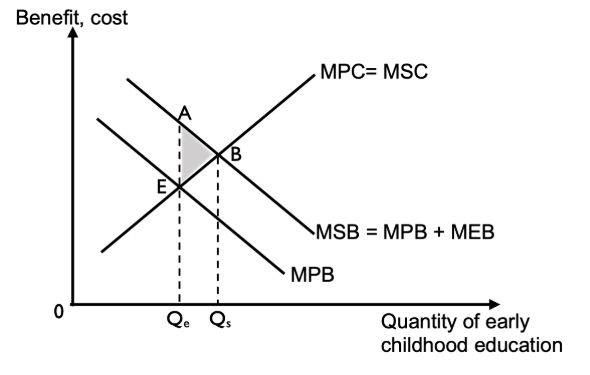
However, ECE also generates MEB to third parties — classmates benefit from peer spillovers, future employers gain from more skilled workers, and society enjoys higher productivity and tax revenues. Hence, MSB = MPB + MEB, and the socially optimal level is Qₛ where MSB = MSC (= MPC). Because parents ignore MEB, consumption remains at Qₑ, below Qₛ. This results in under-consumption by (Qₛ − Qₑ) and a DWL equal to the shaded triangle between MSB and MPC from Qₑ to Qₛ, showing allocative inefficiency.
R2: Imperfect information
ECE is also under-consumed because parents and firms suffer from imperfect information in which they underestimate the benefits of ECE. Parents often focus on immediate costs (fees, time, inconvenience), while undervaluing the additional long-term benefits from one more unit of ECE, such as higher lifetime earnings, better health, and stronger social skills.
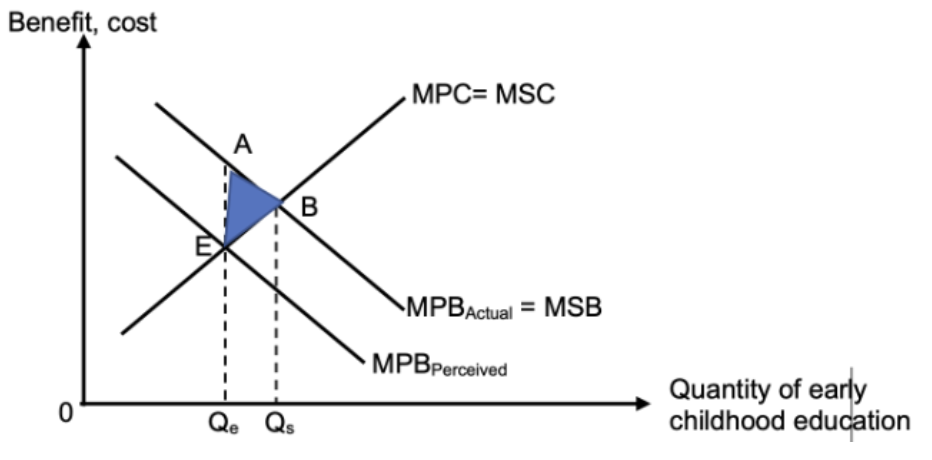
This creates a divergence between perceived MPB (MPBᵖ) and actual MPB (MPBᵃ). Parents choose Qₑ where MPBᵖ = MPC, even though the socially efficient level is Qₛ where MPBᵃ = MPC. As MPBᵖ < MPBᵃ, consumption remains at Qₑ, below Qₛ. This leads to under-consumption by (Qₛ − Qₑ) and a DWL equal to the shaded triangle between MPBᵃ and MPC from Qₑ to Qₛ, again indicating allocative inefficiency.
R3: Inequity and affordability constraints
Finally, under-consumption of ECE arises from inequity in access. In economics, effective demand is defined as willingness and ability to pay. While many parents may be willing to send their children to ECE, lower-income households lack the ability to pay the fees. As a result, they are effectively priced out of the market, and actual enrolment falls short of the socially desirable level.
Referring to Figure 3, this is shown by the effective demand curve (D₀), which lies below D₁, the demand curve that would exist if all households had sufficient purchasing power. With D₀ as the operative demand, the market equilibrium occurs at Qₑ,, below the socially optimal Qₛ.Thus, there is under-consumption by (Qₛ − Qₑ) and a DWL equal to the shaded area from Qₑ to Qₛ. Inequity therefore reduces effective demand, pricing out lower-income households and reinforcing market failure in the case of ECE.
Conclusion
In conclusion, governments consider ECE a merit good because it is socially desirable yet under-consumed when left to the market. This occurs due to positive externalities ignored by parents, imperfect information leading to undervaluation of long-term benefits, and inequity that limits access for poorer households. As a result, governments often intervene through subsidies, free provision, and public education to shift enrolment from Qₑ to Qₛ, eliminating DWL and improving allocative efficiency.
