

Supply-Side Policies (1)
TYS 2023 6b
The use of expansionary demand-side policies designed to achieve economic growth or to lower unemployment may lead to undesirable consequences.
b) Discuss whether expansionary supply-side policies would be effective in achieving the macroeconomic policy aims of an economy. [15]
Introduction
The government aims to achieve four macroeconomic goals: economic growth, low and stable inflation, low unemployment, and a healthy balance of payments (BOP). Expansionary supply-side policies, implemented in both the short and long run, can effectively meet these objectives. However, supply-side policies also face limitations and constraints, which this essay will further discuss
R1: Supply-Side Policies Would Be Effective In Achieving Sustained Growth, Price Stability and Low Unemployment
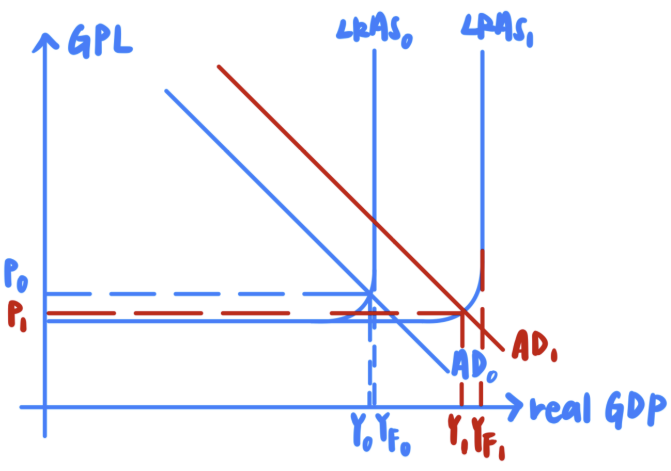
The government can implement supply-side policies to improve labour's quality, quantity, and mobility, thus enhancing the economy’s productive capacity. For example, the Singapore government increased the retirement age from 62 in 2017 to 63 in 2022 and plans to further raise it to 64 by 2026. Raising the retirement age retains more workers in the labour force, thereby increasing the quantity of labour. Additionally, retaining senior, experienced workers enhances the quality of labour due to the workforce being more experienced, and the older workers can also improve the quality of labour for the younger workforce through knowledge transfer. This results in an increase in Long-Run Aggregate Supply (LRAS), shifting the LRAS curve from LRAS₀ to LRAS₁ and increasing full employment output from YF₀ to YF₁, thus potential growth.
Furthermore, higher retirement ages also increase the disposable income of senior workers, boosting their purchasing power. This rise in disposable income encourages greater consumption(C). Since consumption is a component of Aggregate Demand (AD), an increase in C shifts AD rightward from AD₀ to AD₁. With the initial rise in AD and assuming the economy is nearing full employment, firms face an unplanned decrease in inventories, and this signals firms to increase production including labour. Hence, workers now have higher income and purchasing power to spend on domestic goods and services while the rest is withdrawn in terms of savings, taxes and import expenditure. This would then lead to a further unplanned fall in inventories of other firms, inducing a further rise in income induced consumption and the further increase in AD. The cycle repeats itself until the cumulative increase in withdrawals is equal to the initial change in AD. Hence, the increase in AD leads to a multiplied increase in real GDP from Y1 to Y2, resulting in actual economic growth. Demand-deficient unemployment also falls as derived demand for labour increases when firms hire more.
Assuming that the increase in LRAS outpaces the increase in AD, this would lead to a fall in General Price Level (GPL) as seen in the fall of GPL from P₀ to P₁, helping the economy bring down high inflation and achieve non-inflationary growth.
EV1: Depends on Receptiveness
However, shifting mindsets presents a major challenge, as many workers prefer early retirement and may not be receptive to policies extending their working life. Older workers might view extended employment negatively, thereby reducing the actual increase in labour supply and limiting productivity improvements. Thus, the effectiveness of policies like retirement age increments and retraining heavily depends on workers' acceptance and willingness to continue working, potentially constraining actual and potential economic growth as the increase in quantity and quality of labour might not be significant.
However, for more developed countries, citizens are usually more receptive to productivity-enhancing policies, as they tend to possess higher levels of education, digital literacy, and access to retraining opportunities. This allows them to adapt more easily to technological advancements and structural changes in the economy, increasing the effectiveness of such policies in promoting long-term growth and improving living standards.
R2: Supply-Side Policies Would Be Effective In Achieving A Healthy BOT and Price Stability
Supply-side policies that simultaneously increase both aggregate demand (AD) and aggregate supply (AS) can help achieve sustained, non-inflationary economic growth while strengthening Singapore’s balance of trade (BOT).
For example, the Productivity Solutions Grant (PSG) provides subsidies of up to 50% for small and medium-sized enterprises (SMEs) to adopt pre-approved IT solutions, automation tools, and equipment in sectors such as retail, manufacturing, and logistics. By lowering the cost barrier for innovation, PSG increases the quantity and quality of capital, as more firms invest in technology and modern equipment. This enhances efficiency and raises productive capacity, shifting the LRAS rightward from LRAS₀ to LRAS₁. At the same time, higher productivity reduces unit costs of production, allowing firms to expand output without causing upward pressure on the general price level. As a result, the economy experiences sustained, non-inflationary growth, achieving price stability alongside higher output as the analysis mentioned above.
This productivity-driven cost reduction also enhances Singapore’s export competitiveness. Firms that enjoy lower costs can reduce export prices, improving price competitiveness. Assuming the price elasticity of demand (PED) for exports is greater than one, export revenue (X) rises as the increase in export volume outweighs the fall in prices. Furthermore, PSG-supported R&D and innovation raise product quality and differentiation, improving non-price competitiveness. Together, these effects increase demand for exports while encouraging local consumers to substitute imported goods for cheaper, higher-quality domestic alternatives. This leads to a rise in net exports (X–M), strengthening Singapore’s current account balance.
EV2: Long Gestation Period
However, the effectiveness of supply-side policies such as PSG in achieving a healthy BOP might be limited. Firstly, implementing PSG and similar policies requires substantial government funding, leading to significant opportunity costs. Government spending on these grants and subsidies restricts the availability of funds for other essential sectors, such as healthcare, education, and infrastructure. Additionally, the process of research and development supported by these policies is lengthy and complex, requiring considerable time for testing, proving, and implementation, thus limiting immediate impacts. Consequently, in the short run, supply-side policies may not effectively address urgent economic challenges like severe BOP deficits.
Evaluation
In conclusion, supply-side policies typically involve longer implementation and realization timeframes, making them more suitable for long-term economic planning. For short-term economic stabilization and immediate issues such as recessions or inflation, demand-management policies may be more effective. Ultimately, the appropriateness of supply-side policies depends on the specific root causes hindering an economy from achieving its macroeconomic goals. While developed countries with sufficient resources and stable fiscal positions can effectively utilize supply-side strategies, developing countries might initially benefit more from demand-management approaches, addressing urgent short-term economic concerns before progressively adopting long-term supply-side measures.
