

J1s: Decision-Making Frameworks
JPJC 2024 Prelim Q2a
The price mechanism allocates scarce resources in a free market through its signalling, incentive, and rationing functions. However, it may not always achieve the microeconomic goal of efficiency. Therefore, government intervention is often required to ensure efficient resource allocation.
(a) Explain what is involved in rational decision-making by economic agents such as consumers and producers. [10]
Introduction:
A rational consumer and producer aim to maximise utility and profits respectively. They will first gather information on the expected benefits, costs, and constraints before making their decision. If constraints can be overcome, the final choice depends on whether the expected marginal benefits outweigh the marginal costs. Subsequently, both intended and unintended consequences are considered before a new decision is made.
R1: Rational Consumer Decision
When deciding whether to consume a good such as a gym membership or weekly meal subscription, a rational consumer aims to maximise utility. The consumer first considers constraints like limited budget, time, or physical capacity. Next, they weigh expected benefits such as improved health, convenience, or long-term savings, against monetary and non-monetary costs like recurring fees, effort required, or the opportunity cost — for example, forgoing other leisure activities or alternative spending.
To make an informed decision, the consumer gathers relevant information such as service features, user reviews, price comparisons, and personal schedules. They also consider external perspectives, such as peer influence, lifestyle fit, or societal norms. Lastly, the consumer evaluates intended consequences like increased energy levels or cost-efficiency, and unintended consequences such as under-utilisation or commitment fatigue.
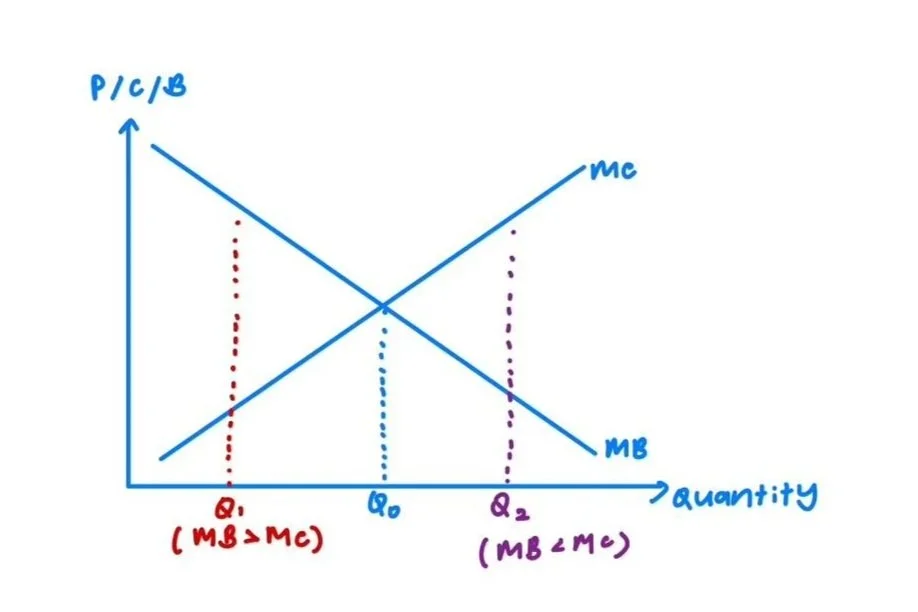
According to the marginalist principle, a rational consumer compares marginal benefit (MB) — the additional satisfaction gained from consuming one more unit of the good — with marginal cost (MC) — the additional cost incurred from that consumption.
The MB curve is downward sloping due to the law of diminishing marginal utility — each additional unit consumed brings less added satisfaction. The MC curve is upward sloping because costs (including opportunity cost) typically rise with more consumption due to limited financial resources, time, or energy.
If MB > MC, the additional benefit exceeds the additional cost, so the consumer will increase consumption. The consumer continues until MB = MC.
If MB < MC, the additional cost exceeds the additional benefit, so the consumer will not increase consumption and may reduce or avoid further purchases.
Thus, a rational consumer will only consume up to the point where MB = MC to maximise utility.
R2: Rational Producer Decision
Similarly, a rational producer aims to maximise profits. Producers begin by considering constraints like rising input prices, machine capacity limits, or labour availability. They weigh potential benefits (e.g. revenue from selling handcrafted notebooks or bottled cold brew) against costs such as wages, raw materials, and delivery logistics. They also gather information such as market demand, competitor prices, and consumer trends, and consider perspectives such as buyers’ preferences or pricing sensitivities. Finally, they assess intended consequences like higher sales revenue and unintended consequences such as oversupply or spoilage.
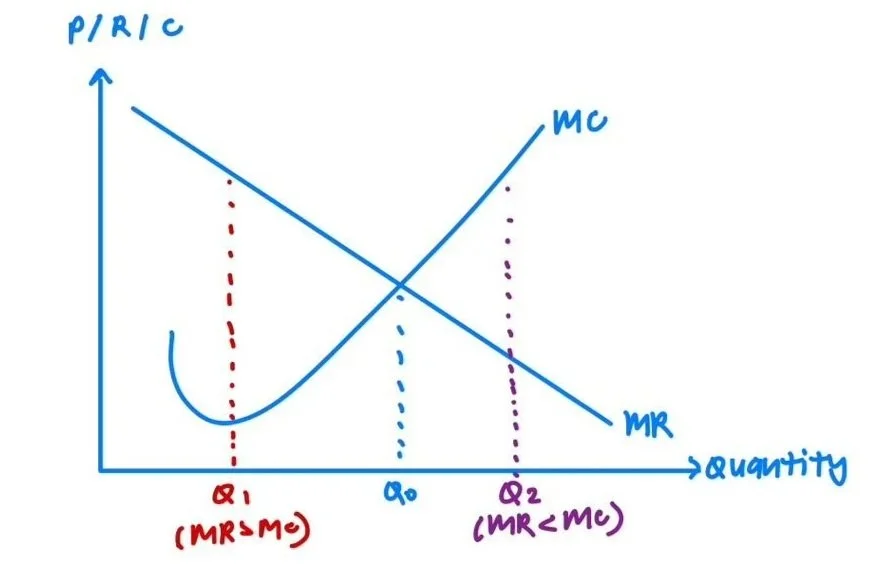
The marginalist principle guides the decision: producers compare marginal revenue (MR) — the additional revenue earned from producing one more unit — with marginal cost (MC) — the additional cost incurred from that production.
The MR curve is downward sloping because producers often have to lower prices to attract additional buyers. The MC curve is upward sloping due to the law of diminishing returns — as more units are produced, additional output becomes more costly due to overuse of fixed resources.
If MR > MC, the additional revenue exceeds the additional cost, so the producer will increase output. The producer continues to produce more until MR = MC, where profit is maximised.
If MR < MC, the additional cost outweighs the revenue earned, so the producer will not increase output.
Thus, a rational producer only produces up to the point where MR = MC to maximise profits.
Conclusion
In summary, rational consumers and producers engage in a structured decision-making process. They identify constraints, gather information, assess marginal benefits and costs, and consider different perspectives and consequences. Ultimately, both apply the marginalist principle — choosing to consume or produce up to the point where marginal benefit equals marginal cost — to achieve utility or profit maximisation.
