

J1: Demand/Supply
RI 2024 Q1
(a) Explain how possible demand and supply factors might contribute to widening income inequality in Singapore. [10]
Introduction
Widening income inequality in Singapore can be attributed to the decrease in demand for low-skilled labour leading to falling wages, as well as the decrease in supply for high-skilled labour leading to higher wages. This results in a widening income gap between the low-skilled workers and the high-skilled workers, contributing to the widening income inequality in Singapore.
R1: Explain how a decrease in demand for low-skilled labour might contribute to widening income inequality in Singapore
Firstly, the decrease in demand for low-skilled labour can be caused by government regulation in light of globalisation. Due to globalisation, with the availability of cheap and abundance of labour in other countries which caused many manufacturing and labour intensive industries like textiles to offshore to other countries from SIngapore, the Singapore government realised that Singapore will eventually lose its export competitiveness and comparative advantage in labour intensive and manufacturing sectors, Thus, the government shifted focus to the high-end technological sector, For instance, Singapore used to be a fishing port and produced lots of textiles for exports, however with globalisation, the government shifted focus to develop high end sectors through export-oriented industrialization, implementing policies like the export credit insurance scheme that attracted many MNCs. This thus resulted in a decrease in demand for low-skilled labour, causing a leftward shift of the demand curve from Dd0 to Dd1. The quantity demanded for low-skilled labour decreased from Q0 to Q1, and wages fell from W0 to W1.
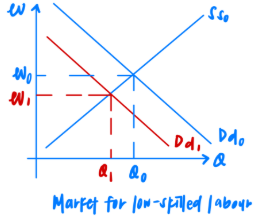
Furthermore, the demand for low-skilled labour is elastic as low-skilled labour has various substitutes available and thus is easily replaceable with automation and machinery. This indicates that the wages of low-skilled labour might fall more than proportionately when there is a fall in demand for low-skilled workers, further widening the income inequality issue in Singapore.
R2: Explain how a decrease in supply of high-skilled labour might contribute to widening income inequality in Singapore
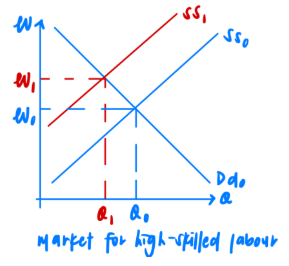
Secondly, the decrease in supply of high-skilled labour has caused an increase in wages for high-skilled labour. IN recent years, the Singapore government has tightened its immigration policies for high-skilled labour, this to ensure that the local workforce is prioritised and to address growing concerns over job competition. The government raised the minimum salary requirement for new employment pass holders to $5000 and $5500 for those in the financial service sectors. This thus restricts the supply of high-skilled labour as firms cannot rely on the foreign labour supply as much. This thus leads to a decrease in supply of high-skilled labour from Q0 to Q1 caused by a leftward shift in the supply curve from Ss0 to Ss1, and thus wages increase from P0 to P1.
Conclusion
With the falling wages in low-skilled labour and rising wages in high-skilled labour, Singapore’s income inequality is thus widening.
