

J2: Fiscal Policy: Government Spending vs Taxation
RJC Q5b
Sustainable economic growth relies on government spending in green energy infrastructure, including solar and wind power, as well as transport systems like electric vehicle networks and high-speed rail. Carbon taxes also play a crucial role in promoting eco-friendly practices
(b) Discuss whether government spending on green energy infrastructure or taxing carbon is the more appropriate policy to achieve sustainable economic growth.
Introduction
Sustainable economic growth is one which can be maintained without significant trade offs to the future generation, such as depleted resources and environmental degradation. Spending on green energy infrastructure and taxing carbon are both appropriate policies that can achieve sustainable economic growth, their benefits and limitations will be further discussed in the essay below.
R1: Spending on green energy infrastructure is the more appropriate policy to achieve sustainable economic growth
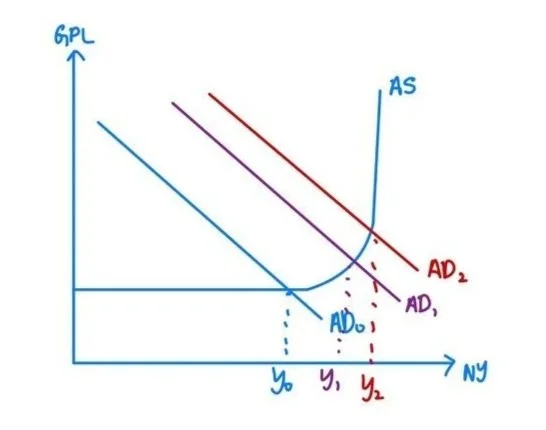
Spending on green energy infrastructure is indeed a feasible and appropriate policy to achieve sustainable economic growth. Channeling government funds and investing towards green energy infrastructure such as “solar and wind power” as mentioned in the preamble will result in an increase in both government (G) and investment (I) expenditure. This will lead to an increase in AD since G and I are components of AD, shifting the AD curve rightwards from AD0 to AD1. This will trigger the multiplier process where further rounds of income-induced spending and respending is made, leading to a multiplied increase in AD from AD0 to AD2, with reference to figure 1. The increase in national income will also be multiplied from Y0 to Y2.
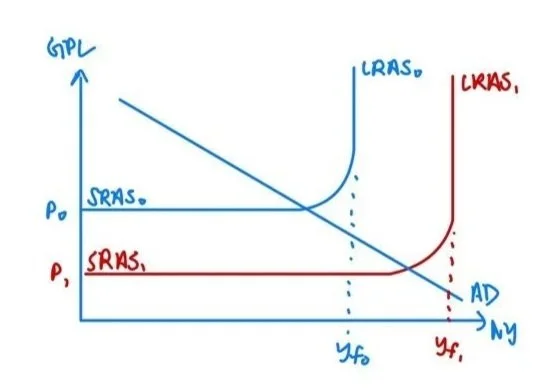
In the long run, spending on green energy such as “transport systems like electric vehicle networks and high-speed rail” as mentioned in the preamble will achieve potential growth as it increases the productive capacity of an economy. High speed rail networks can increase the mobility of labour, a factor of production, thus increasing the quantity of labour. It also leads to a reduction in long-term energy cost and improved efficiency, leading to higher productivity and lower unit cost of production, assuming that the increasing rate of productivity is higher than that of wages. This will lead to an increase in both SRAS and LRAS, shifting LRAS rightwards and SRAS downwards from LRAS0 to LRAS1 and SRAS0 to SRAS1 respectively, with reference to figure 2. High speed rail networks can effectively reduce the long-term environmental impact as it reduces greenhouse gas emissions and pollution from car exhaust, thus conserving natural resources and energy for future use. Furthermore, using green energy such as solar and wind power will also reduce the burning of fossil fuels thus reducing harmful particles in the air and improving the air and water quality. Hence achieving sustainable economic growth.
Evaluation 1
However, even though spending on green energy infrastructure can indeed achieve sustainable economic growth, it has its limitations as well. Firstly, investing in green energy infrastructure requires a huge sum of funds which might put a strain on a country’s government budget. If these projects are funded by national reserves, increasing tax, and/or borrowing from other countries, the outcome may backfire on the aims to achieve sustainable growth as these are merely an intergenerational transfer of standard of living (SOL) and the future SOL of the citizens will be hurt. Furthermore, opportunity cost will also be incurred whereby the funds spent on green energy infrastructure cannot be used to develop the technological and healthcare sectors of the country. Secondly, spending on green infrastructure and building rail networks is a long-drawn process given the complexity and high technical process thus its effects cannot be seen in the short run. This may not be the best choice for countries experiencing severe air pollution thus a more quick policy will be needed to help these countries achieve sustainable growth within a short period of time.
R2: Taxing carbon is the more appropriate policy to achieve sustainable economic growth
Carbon taxes increase the cost of producing carbon-intensive goods and services thus incentivising firms to increase investment expenditure (I) and look for other alternatives in greener technology so as to reduce the tax burden from the government. An increase in I will lead to a direct increase in AD, causing AD to shift rightwards and trigger the multiplier process where the several rounds of spending and re-spending will lead to a multiplied rise in national income, thus achieving actual growth. The shift towards more sustainable and efficient production methods also increases the productive capacity of the economy as greener technology results in cleaner air quality due to the decrease in air pollution levels, thus enhancing the quality of labour, hence achieving potential growth. Additionally, carbon taxes encourage the conservation of resources by making carbon-intensive activities more expensive, hence ensuring that future generations have access to essential resources. Investments in cleaner technology resulting from high carbon tax rates will also reduce carbon production thus improving the living environment of future generations, hence achieving sustainable economic growth.
Evaluation 2
However, the effectiveness of carbon taxes in encouraging firms to invest in research and development (R&D) for cleaner production methods depends on the tax level. If the carbon tax is too low, firms may find it cheaper to pay the tax than invest in R&D, limiting innovation and pollution reduction at the firm level. Additionally, in the short-run, carbon taxes can raise production costs, leading to cost-push inflation and slower economic growth. This may lead to an increase in unemployment rate and disruptions, especially in industries reliant on fossil fuels. Furthermore, imposing a carbon tax will result in unintended consequences as carbon taxes are regressive, which will disproportionately affect the lower-income households who spend a larger share of their income on energy related expenses, thus increasing their financial burden.
Conclusion
In conclusion, whether government spending on green infrastructure or imposing carbon taxes is the more appropriate way to achieve sustainable growth depends on several factors. For developed countries to achieve sustainable growth, increasing spending on green infrastructure may be the more appropriate policy as developed countries often have sufficient funds for the government to invest in greener projects, without creating outcomes that may backfire on the initial aim such as an intergenerational transfer of SOL from future to present. Whereas for developing countries, it is more feasible to impose a carbon tax to achieve sustainable economic growth. This is so as the tax revenue generated from carbon tax will allow the government to have enough funds to fund other cheaper alternatives. However, developed countries with pressing environmental issues will have to opt to impose a carbon tax in the short run as its effects are more immediate as compared to that of green technology, whose benefits can only be reaped in the long run. With that said, even though carbon tax can achieve sustainable growth in a short period of time as it incentivises firms to reduce carbon emissions, it may lead to unintended consequences. For example, companies might switch to biofuels, which can lead to deforestation and water pollution due to fertilizer runoff. A shift to natural gases might also increase methane leaks even though it lowers carbon dioxide emissions. Hence, the government can use a mix of both policies in both the short run and the long run to achieve a long-lasting sustainable economic growth while minimizing the negative impacts and unintended consequences of these policies. The government will also have to come up with other regulations to mitigate the negative impacts on the environment.
