

J1: Microeconomic Policies
RI 2024 Q1b
(b) Discuss the extent to which a minimum wage law is more appropriate than a tightening foreign worker quota policy to reduce income inequality in Singapore. [15]
Introduction
Minimum wage law and tightening foreign worker quota policy to reduce income inequality in Singapore had both their benefits and limitations. This essay will discuss whether minimum wage is more appropriate than tightening foreign worker quota policy, both their effectiveness, limitations, and the unintended consequences that may follow.
R1: Minimum wage law is more appropriate to reduce income inequality in Singapore.
Minimum wage law is one whereby the wage is set above the equilibrium wage of P0, at Pmin, acting as a price floor. The minimum wage is set by the government to be the lowest hourly, weekly, or monthly pay an individual should receive. It aims to raise the living standards of low-skilled workers, ensuring that they are not exploited and overworked for their salary. This can effectively reduce income inequality as it ensures the low-skilled a minimum wage to take home, rather than leaving it to firms to decide their wage, which are often low due to their profit-maximizing nature. At the new wage Pmin, the supply of labour increases as more people are willing to work at this higher wage enter the market, causing the supply of labour to increase to Qss. However, at the higher wage, firms are less willing to hire workers as it increases their cost of production, the demand for labour thus decreases to Qdd. Since the quantity demanded for labour is lesser than the quantity supplied, there is a surplus of labour, resulting in unemployment.
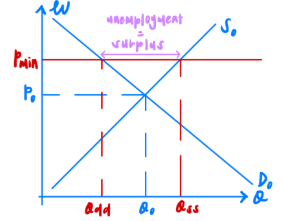
In Singapore, the government implements the progressive wage model, which sets minimum wage standards for specific sectors like cleaning, security, and landscaping, For example, the cleaning sector is required to have a minimum monthly salary of $1512, which is higher than what workers previously earned.
Evaluation 1
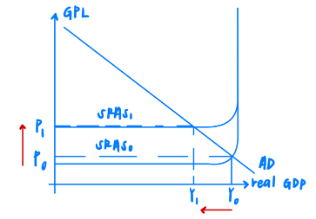
However, minimum wage may in turn worsen income inequality as sectors like the aforementioned cleaning and security are often easily replaceable by automation and robots. Robotic surveillance and robotic cleaning technology make the demand for low-skilled labour very price elastic. Thus, an increase in wages due to the minimum wage law of the progressive wage model may cause a more than proportionate decrease in demand for low-skilled labour, thus resulting in unemployment, further exacerbating the widening income gap. The income gap will be magnified as low-skilled workers will still be able to bring home some income initially without the minimum wage law. With the minimum wage law implemented and low-skilled workers getting replaced with automation, these retrenched low-skilled workers have zero income, thus worsening the income inequality even further. Furthermore, implementing a minimum wage law may also lead to unintended consequences such as stagflation. Minimum wage law increases the cost of production of firms, leading to a fall in short-run aggregate supply (SRAS), shifting the SRAS curve upwards from SRAS0 to SRAS1. This leads to an increase in the general price level from P0 to P1 and a fall in national income from Y0 to Y1, leading to stagflation.
R2: Tightening foreign worker quota policy is more appropriate to reduce income inequality in Singapore
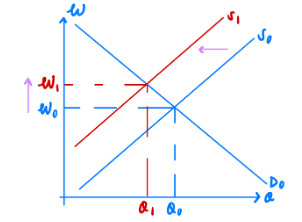
Tightening the foreign worker quota policy in terms of restricting the supply of low-skilled labour can effectively reduce income inequality in Singapore. The Singapore government can decrease the pool of low-skilled labour available through getting foreign worker quotas, such as the dependency ratio ceiling (DRC), to regulate the number of foreign workers firms can hire in proportion to their local workforce. The DRC sets the maximum ratio of foreign workers relative to their workforce, which varies across different sectors. For instance, in the service sector, DRC sets a foreign workers quota policy of 35% whereas for the construction sector can hire up to 87.5% of foreigners, By tightening and decreasing the percentage in these industries, firms will face a decrease in supply of low skilled labour as they cannot rely as much on foreigners. This can be seen in the leftward shift of the supply curve from S0 to S1, thus leading to an increase in wages for low-skilled workers from W0 to W1, hence decreasing income inequality.
Evaluation 2
Though this might sound effective in theory, in reality, Singaporeans are less inclined to take up jobs, especially in the construction sector, as they are labour-intensive and require individuals to work under tough conditions and be involved with ground operations. In this case, tightening the foreign worker quota policy may not decrease income inequality and may even result in a fall in economic growth as firms face a shortage of labour as a factor of production. The government’s provision of infrastructure, like public housing, schools, and public transport systems, may even experience a delay in progress due to the lack of low-skilled labour. However, with that being said, if the government tightens the foreign worker quota policy very strictly, which results in a more than proportionate increase in wages, more Singaporeans may be enticed to join these industries.
Conclusion
In conclusion, the government should use a mixture of both policies to reduce income inequality in both the short and long run. In the short run, the Singapore government should adopt the minimum wage law to address the concerns among the low-income group to increase their standard of living and ensure that they have the willingness and ability to consume necessities such as food. However, this is not sustainable in the long run as it might lead to unemployment and stagflation, thus backfiring on the economy and rendering this measure ineffective. As such, this policy should be used together with the foreign worker quota policy to adequately control the number of foreign low-skilled labour in Singapore to mitigate the widening income gap in Singapore. Alternatively, the Singapore government should also find out the root cause of the income inequality in Singapore. As Singapore focuses on higher value-added industries, there may be a mismatch of skills between what employers are looking for and what workers are equipped with, thus leading to high income inequality. If this is the case, the Singapore government can implement policies to address the mismatch of skills to increase the household income of low-skilled individuals.
