

TYS 2022 3a
Street lighting is considered to be a public good. However, there are negative externalities resulting from the generation of electricity for the lighting on the environment and the effect of bright street lights on wildlife.
a) Explain two different reasons for the market failure associated with the provision of street lighting. [10]
Introduction
Market failure occurs when free markets, operating without any government intervention, fail to deliver an efficient allocation of resources to produce goods and services. This essay will be explaining why the market mechanism will fail to provide the correct prices for both public goods and goods with negative externalities, allowing government intervention to improve resource allocation.
R1: Complete market failure due to the public good nature of street lighting
Street lighting is a public good, defined by its characteristics of non-excludability, non-rivalry, and non-rejectability. Non-excludability means that once the good is provided, it is prohibitively expensive or impossible to exclude non-payers from consumption. For instance, once street lights are installed, all individuals—including foreigners or non-taxpayers—can benefit from the safety and illumination they provide at night. As a result, no consumer reveals their true willingness and ability to pay, and there is no effective demand in the price mechanism.
In addition, street lighting is non-rivalrous—one person’s consumption does not diminish the quantity or quality available to others. As such, the marginal cost (MC) of providing the good to one more consumer is zero as marginal cost is defined as the additional cost incurred from producing or providing one more unit of a good or service. Since allocative efficiency is achieved where price equals marginal cost (P = MC), the efficient price should be zero. However, if the price is zero, no rational producers will produce a good in which the price is zero, and hence there will be no effective supply.
Therefore, the combined effect of non-excludability and non-rivalry leads to a missing market—where no private provision occurs and zero resources are allocated. This results in complete market failure unless the government intervenes.
R2: Market failure due to presence of negative externalities
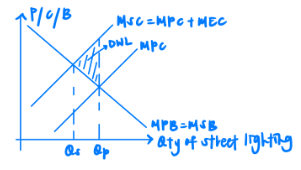
Market failure arises due to negative externalities in production of electricity-powered street lighting. When deciding how much to produce, producers only consider their self-interest where they weigh the marginal private cost (MPC) against the marginal private benefit (MPB). The MPC is the additional cost incurred for one more unit of street lighting, such as the monetary cost of installation and maintenance fees, while the MPB is the additional benefit from producing one more unit of street lighting such as enhanced visibility and public safety. Thus, producers will produce at QM where MPB = MPC due to self-interest.
However, the provision of street lighting gives rise to marginal external costs (MEC) borne by third parties. These include pollution from electricity generation, which releases toxic emissions that can lead to respiratory issues for nearby residents, thereby increasing healthcare costs and reducing labour productivity. Additionally, excessive artificial lighting may disrupt nocturnal wildlife, leading to more animals wandering onto roads and increasing the risk of traffic accidents.
As these negative externalities are not reflected in the private cost of production, there is a divergence between marginal private cost (MPC) and marginal social cost (MSC), where MSC = MPC + MEC. The socially optimal level of production is at Qs, where marginal social benefit (MSB) equals MSC, and social welfare is maximised. However, producers operating in self-interest will produce at Qm, where MPB = MPC, resulting in overproduction (Qm > Qs) and an over-allocation of resources to street lighting. This leads to a deadweight welfare loss, represented by the shaded triangle ABC, indicating a loss in total societal welfare. Hence, allocative inefficiency arises, causing market failure.
Conclusion
Market failure thus occurs in the market for street lighting as it is a public good and has negative externalities causing it to be unable to achieve allocative efficiency leading to market failure.
