

VJC 2024 prelims Q5
In early 2022, Sri Lankans started experiencing power cuts and shortages of basics such as fuel. The rate of inflation rose to 50 per cent while unemployment rate remains high. Currently, Sri Lanka owes about $7 billion to China and around $1 billion to India.
b) Discuss the extent to which the Sri Lankan government should focus on reducing its inflation rate over reducing its unemployment rate.
Introduction
High inflation and unemployment both negatively impact Sri Lanka’s economic growth and standard of living (SOL). Inflation, which can be demand-pull (caused by excessive aggregate demand) or cost-push (caused by rising production costs), erodes purchasing power and creates economic instability. Unemployment, which can be cyclical, structural, or frictional, leads to lower incomes and reduced national output. Given Sri Lanka’s 50% inflation rate and persistently high unemployment, the government faces a policy trade-off in deciding which issue to prioritize. This essay will evaluate the extent to which reducing inflation should take precedence over reducing unemployment in Sri Lanka’s current economic context.
R1: The Sri Lankan government should focus on reducing its inflation rate over its unemployment rate to a large extent
With inflation at 50%, the Sri Lankan government should focus on reducing inflation over unemployment, as high inflation erodes real incomes, weakens business confidence, and ultimately increases unemployment.
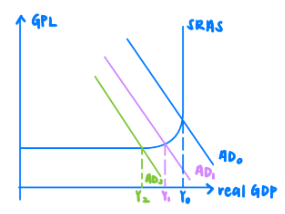
Firstly, inflation diminishes real income, as wages may not rise as quickly as the general price level. This reduces purchasing power, forcing households to cut back on essential goods and services, worsening material standard of living (SOL). Additionally, high inflation discourages investment expenditure (I), as firms face uncertainty over future costs and demand. This leads to a fall in aggregate demand (AD), shifting AD leftward from AD0 to AD1 to AD2, reducing national income from Y0 to Y2 and worsening unemployment due to lower derived demand for labor.
OR
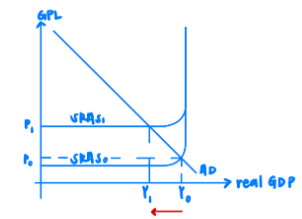
Secondly, cost-push inflation from power cuts and fuel shortages exacerbates economic instability by increasing firms' unit costs of production. Rising energy and raw material costs force firms to reduce output, as production becomes less profitable. This results in a leftward shift in short-run aggregate supply (SRAS) from SRAS0 to SRAS1, leading to a rise in the general price level from P0 to P1 while real GDP falls from Y0 to Y1. As output declines, firms experience lower revenues and may struggle to cover wage costs, leading to layoffs or hiring freezes. Since labor is a derived demand, lower output levels mean fewer workers are needed, increasing unemployment. Thus, reducing inflation can help mitigate economic uncertainty, restore business confidence, and stabilize output, which in turn naturally reduces unemployment in the long run.
Evaluation 1
HoweWhile reducing inflation is important, the extent to which it should be prioritized over unemployment depends on the cause of inflation. If inflation is primarily demand-pull, it may not be as urgent, as it could indicate strong economic growth rather than a crisis. For example, Sri Lanka welcomed 700,000 tourists in 2022 as post Covid recovery, generating USD 1.3 billion in tourism revenue, which increased aggregate demand (AD) and contributed to demand-pull inflation. However, this also stimulated business activity and job creation, meaning inflation in this case may not be a pressing concern. Thus, the government should differentiate between demand-pull and cost-push inflation and adopt targeted policies that control inflation without unnecessarily increasing unemployment.
R2: Sri Lankan government should focus on reducing unemployment rate due to the negative consequence on the economy
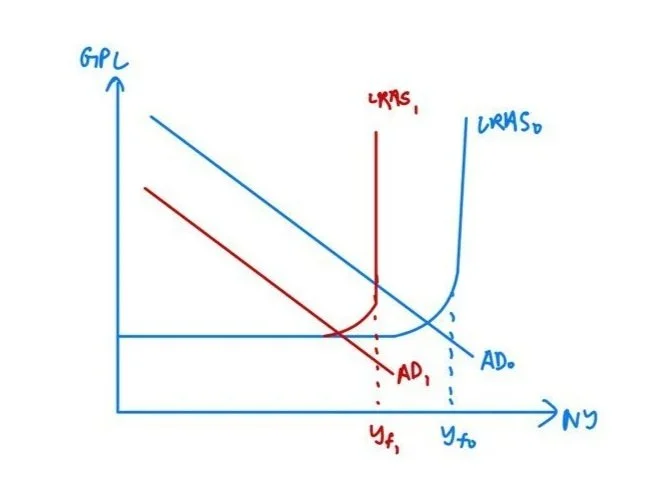
However, the Sri Lankan government should prioritize reducing unemployment if it is primarily cyclical, as it signals a fall in aggregate demand (AD), national income, and output, leading to lower derived demand for labor. High unemployment reduces household incomes, lowering purchasing power and forcing individuals to switch to lower-quality goods and services, worsening material SOL. The stress of joblessness also deteriorates non-material SOL. Additionally, rising unemployment increases the government’s welfare burden while reducing tax revenue, straining public finances. Social unrest and crime may rise due to widening income inequality, deterring foreign investment and destabilizing the economy, further slowing growth. If left unaddressed, persistent unemployment leads to skill deterioration (hysteresis), shifting long-run aggregate supply (LRAS) leftward, reducing Sri Lanka’s productive capacity and long-term growth potential.
Evaluation 2
While high unemployment has severe consequences, it may not always require immediate intervention, especially if it is frictional unemployment. Frictional unemployment arises when workers take time to transition between jobs, such as recent graduates or individuals voluntarily switching careers. This type of unemployment is typically short-term and does not indicate a structural weakness in the economy. Additionally, if Sri Lanka’s unemployment is structural, caused by a mismatch between workers’ skills and industry demands, simply stimulating aggregate demand will not effectively reduce unemployment. Instead, long-term solutions like education and retraining programs would be necessary. Therefore, before prioritizing unemployment reduction, the government must assess whether the job losses are cyclical or due to other factors, as different types of unemployment require different responses.
Conclusion
In conclusion, whether the Sri Lankan government should prioritize reducing inflation or unemployment depends on which brings greater economic stability. Given Sri Lanka’s high debt and 50% inflation rate, tackling inflation should come first, as it restores purchasing power, stabilizes consumption, and boosts tax revenue, improving government finances. Lower inflation can also lead to higher national income and output, increasing derived demand for labor and reducing unemployment in the long run.
However, Sri Lanka's high unemployment rate despite extreme inflation suggests that the economy is already struggling with stagflation, where both inflation and joblessness persist simultaneously. This means reducing inflation alone may not be enough—structural weaknesses such as power shortages and supply chain disruptions may still constrain growth and job creation. Therefore, while inflation control should be the immediate priority, it must be accompanied by long-term supply-side improvements to ensure a sustainable recovery that addresses both inflation and unemployment effectively.
