

J1: Microeconomic Policies
Lighthouse Essay
b) Discuss how the rising household income and increased GST might impact consumer expenditure in the markets for essential goods such as groceries and recreational items such as travel. [15]
Introduction
Consumer expenditure is influenced by a range of factors, including changes in household income and indirect taxes such as the Goods and Services Tax (GST). In the Singapore context, recent macroeconomic developments include a 4% rise in household income and a GST increase from 7% to 9%. These changes have differing impacts on markets for essential goods, such as groceries, and discretionary goods, such as travel and other recreational items. This essay will analyse how these factors affect consumer expenditure, taking into account the relative elasticities of demand and the market adjustment process. Diagrams and theoretical frameworks such as income elasticity of demand (YED) and price elasticity of demand (PED) will be used to illustrate the differing impacts on both markets.
R1: Rising household income will increase consumer expenditure for both essential goods and recreational items
Rising household income increases consumers’ purchasing power, which in turn increases their willingness and ability to purchase more goods and services. This results in a rightward shift of the demand curve from D0 to D2. At the original equilibrium P0Q0, demand rising will lead to quantity demanded rising from Q0 to Qdd while quantity supplied remains at Q0=Qss. Since quantity demanded exceeds quantity supplied, this creates a shortage of Qdd-Qss, which puts an upward pressure on the price to rise. As price rises, quantity demanded will decrease while quantity supplied will rise until the new market equilibrium, P1Q1, where the shortage is eliminated.
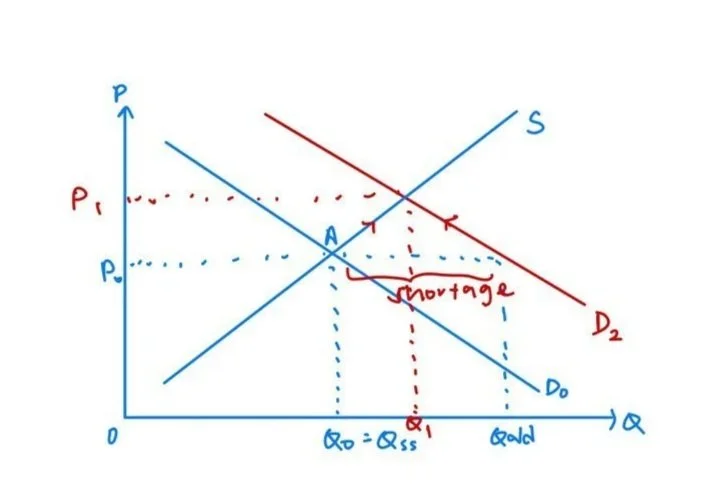
Income elasticity of demand (YED) measures the responsiveness of the percentage change in demand for a good to a percentage change in consumer income, ceteris paribus. Essential goods have low income elasticity of demand (0<YED<1) , where demand for groceries is income inelastic. This is due to groceries having a high degree of necessity with it being our food source required for survival and it takes a low proportion of consumer income. Hence, when income increases, the increase in demand is less than proportionate, shifting from D0 to D1. Through the market adjustment process as mentioned above, this leads to a less than proportionate increase in both price and quantity, therefore a less than proportionate increase in consumer expenditure from 0Q0P0A to 0P1Q2B.
Recreational goods have high income elasticity of demand (YED > 1), where demand for travel is income elastic. This is due to travel having a low degree of necessity, as it is a discretionary activity, and it takes a high proportion of consumer income, since travelling involves costs such as transport and accommodation. Hence, when income increases, the increase in demand is more than proportionate, shifting from D0 to D2. Through the market adjustment process as mentioned above, this leads to a more than proportionate increase in both price and quantity, therefore a more than proportionate increase in consumer expenditure from 0Q0P0A to 0P2Q2C.
EV1: Uneven income distribution may limit the extent of increase in expenditure on recreational goods
While recreational goods are income elastic, the extent of the rise in consumer expenditure depends on who benefits from the income increase. The 4% rise in income may only be concentrated among higher-income households. This means that lower-income groups may not have increased purchasing power and disposable income especially during the context of COVID and the already existing issue of rising food prices mentioned in the preamble. As a result, the more than proportionate increase in demand in the market of recreational goods will be to a smaller extent particularly for lower- and middle-income segments, dampening the actual rise in consumer expenditure on recreational goods.
R2: Increased GST will increase consumer expenditure for essential goods but decrease consumer expenditure for recreational items
An increase in GST, which is an indirect tax on goods and services, raises the cost of production for firms. This reduces the willingness and ability of producers to supply goods, causing the supply curve to shift leftwards from S0 to S1. Following the same price adjustment process as above, the fall in supply creates a shortage of Qdd-Qss thus putting upward pressure on price until the new equilibrium at P1Q1.
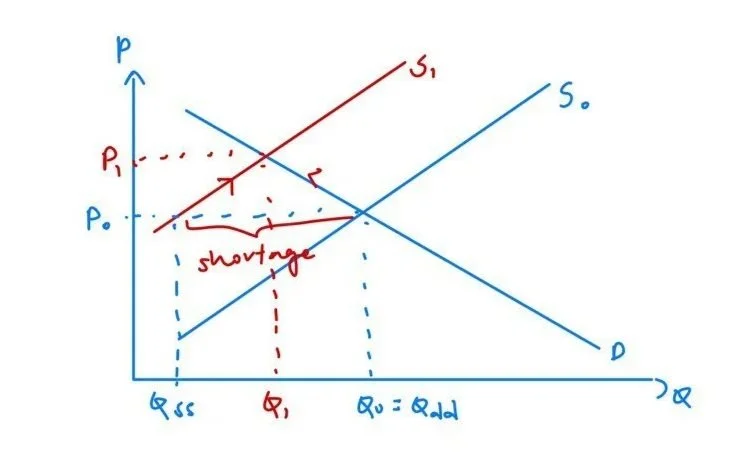
Price elasticity of demand (PED) measures the responsiveness of quantity demanded of a good to a change in its price, ceteris paribus. The demand for essential goods such as groceries is price inelastic, PED < 1. This is because they have a high degree of necessity and low availability of substitutes due to the essential nutrients required for daily survival. Hence, in the market for essential goods, the increase in GST coupled with the steep demand curve for essential goods represented by Dinelastic , leads to a less than proportionate fall in quantity demanded and more than proportionate rise in price. Hence, consumer expenditure increases, as shown by the expansion in total expenditure area from 0Q0P0A to 0P1Q1B.
The demand for recreational goods such as travel is price elastic (PED > 1). This is because they have a low degree of necessity and a high availability of substitutes, as consumers can choose alternative forms of leisure or forgo such spending altogether. Hence, in the market for recreational goods, the increase in GST coupled with the flat demand curve for recreational goods represented by Delastic, leads to a more than proportionate fall in quantity demanded and a less than proportionate rise in price. Hence, consumer expenditure decreases, as shown by the contraction in total expenditure area from 0Q0P0A to 0P2Q2C.
Evaluation
The overall impact on consumer expenditure depends on the relative strength of rising income and the GST hike. While a 4% increase in household income boosts purchasing power, this may be offset by the 2% GST increase and the 6.5% rising food prices as mentioned. Hence, the rise in expenditure due to income increase in the market for recreational goods might be outweighed by the larger fall in consumer expenditure due to the GST hike.
Furthermore, in the context of the ongoing COVID-19 situation, uncertainty over job stability and future income may cause households to withhold discretionary spending as a precautionary measure. This means that, despite rising incomes, many consumers may prioritise essential goods and cut back on non-essential expenditure such as travel. Hence, the rise in consumer expenditure in the market for recreational goods will only be to a smaller extent.
